

Updated August 10, 2026
Washington, DC may be famous for its spring cherry blossoms, but I think autumn is just as spectacular. By late October, the city’s tree-lined neighborhoods, gardens, parks, and monuments glow in shades of crimson, orange, and gold.
You can hike beside a creek in Rock Creek Park, wander beneath fiery trees on Capitol Hill, photograph colorful Georgetown row houses, or watch autumn leaves frame the monuments on the National Mall. Some of my favorite fall scenes appear in unexpected places—including sculpture gardens and hidden garden paths.
I walk Washington, DC year-round, but fall is my favorite season to explore the city on foot.
Here are my 15 best places to see fall foliage in Washington, DC, from famous landmarks to neighborhood streets and secret gardens.

Table of Contents
Rock Creek Park
Rock Creek Park feels worlds away from Washington, DC’s monuments and museums. In fall, the park’s wooded trails glow with shades of yellow, orange, and red. Follow a trail beside Rock Creek to photograph colorful leaves reflected in the water.
This is one of my favorite places to experience fall foliage in Washington, DC, in a natural setting. You can hike beneath a canopy of mature trees, cross picturesque bridges, or simply enjoy the sound of the creek. It’s hard to believe such a peaceful woodland escape exists in the middle of the nation’s capital.

Boulder Bridge is one of the park’s most picturesque historic bridges for an autumn photograph. The historic bridge is built from large stones and spans Rock Creek.
Capitol Hill
Capitol Hill is one of the prettiest Washington, DC neighborhoods for an autumn walk. Mature trees shade sidewalks lined with historic row houses, colorful doors, iron fences, and small front gardens. In fall, those leafy streets turn brilliant shades of gold and orange.

Wander beyond the U.S. Capitol and explore the residential streets surrounding Eastern Market. I love how the fall foliage frames Capitol Hill’s distinctive architecture. Bring your camera because almost every block offers another classic Washington, DC scene.
Georgetown
Georgetown is gorgeous year-round, but fall brings something extra to Washington, DC’s oldest neighborhood. Orange and red leaves provide a dramatic backdrop for Federal-style row houses, cobblestone streets, hidden alleys, and historic churches.

Skip M Street for a while and wander the quieter residential streets instead. Look for brightly colored doors, window boxes, ivy-covered brick, and trees arching over the sidewalks. Georgetown in fall was made for exploring on foot—and photographing along the way.
Bishop’s Garden at Washington National Cathedral
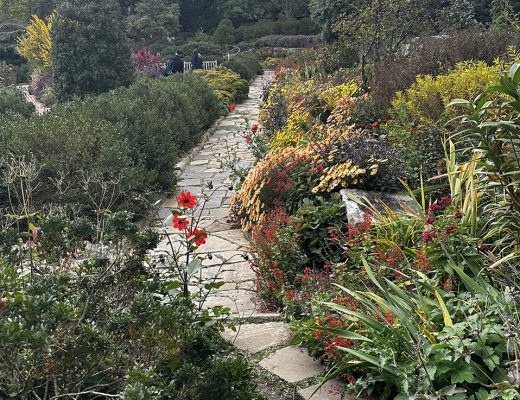
Tucked beside Washington National Cathedral, Bishop’s Garden is one of Washington, D.C.’s most enchanting places for a fall stroll. Stone pathways wind through intimate garden spaces filled with trees, shrubs, flowers, and architectural details. Autumn foliage makes this already romantic garden even more beautiful.

Take time to explore the garden before walking around the Cathedral grounds. Look for colorful leaves framing stone walls, Gothic architecture, and quiet seating areas. Bishop’s Garden offers a completely different fall experience from the National Mall—and admission to the outdoor garden is free.
National Mall
I always tell visitors that if they only have one day to tour Washington, DC, then they should devote it to walking the National Mall. (The distance from the U.S. Capitol steps to the Lincoln Memorial spans 1.9 miles.)
“This is where the nation comes to remember and where history is made. As ‘America’s Front Yard,’ the National Mall and Memorial Parks is home to many of our country’s most iconic memorials telling the story of people and events that shaped us as a nation.”
National Park Service
During the fall, brightly colored orange, golden, and red trees bloom along the sidewalks and paths of the National Mall. Moreover, visitors can easily exit the green to visit the Smithsonian museums.
Hirshhorn Sculpture Garden
Hirshhorn Museum and Sculpture Garden will officially reopen its 1.4-acre outdoor sculpture garden on October 31, 2026. The grand reopening follows an extensive four-year, $68 million modernization and revitalization project designed by artist and architect Hiroshi Sugimoto.

There are several large trees that turn bright orange in the autumn. This contrasts beautifully with the bold red abstract work installed on the lawn. There are more than 30 works of art displayed year-round.
“Built to house Joseph H. Hirshhorn’s world-renowned sculpture collection, the sculpture garden offers a peaceful haven 14 feet below the surface of the Mall to observe and contemplate a rotating array of modern art.”
Smithsonian
The garden opened in 1974. Sculptures comprised nearly a fourth of Joseph Hirshhorn’s initial gift. They allow residents and visitors alike to view modern sculptures outdoors in a meditative haven. The Hirshhorn Sculpture Garden should be visited during each of the four seasons to see how nature perfectly complements the collection of modern sculpture.
Mary Livingston Ripley Garden
There are two Smithsonian museum gardens where you will see brilliant fall foliage.

The first is tucked away in an alley between the Hirshhorn Museum and the Smithsonian Arts and Industries Building. If you ever read The Secret Garden written by Frances Hodgson Burnett, then you will know the joy of wandering this space. I always remember her admonition that as long as you have a garden, you have a future.
“And the secret garden bloomed and bloomed and every morning revealed new miracles.”
Frances Hodgson Burnett
During autumn, the curvilinear design allows you to step into autumn’s glory by the profusion of trees and flowers dressed in seasonal colors. Washington, D.C. architect Hugh Newell Jacobson designed the gardens. There is a main fountain framed by islands of flowers in raised beds. The deep red bricks of the august Smithsonian castle serve as a backdrop.
The Mary Livingston Ripley Garden is named after the wife of Smithsonian Secretary S. Dillon Ripley. She conceived the idea for a “fragrant garden” on the eastern border of the Arts and Industries Building.
Enid Haupt Gardens
After wandering past the intimate collection of benches, hanging flower baskets, and raised flower beds, you exit on Independence Avenue. It is a short walk up the road to tour the Enid Haupt Gardens. Come visit in the autumn to enjoy a picnic lunch outside.

This 4.2-acre “rooftop” garden is part of the Smithsonian complex. Situated outside the Smithsonian Castle, the Enid A. Haupt Garden opened on May 21, 1987. It is named after the American publisher and philanthropist Enid Haupt.
“Few visitors to the Haupt Garden realize that they are standing on the roofs of the National Museum of African Art, the Arthur M. Sackler Gallery, and the S. Dillon Ripley Center.”
Smithsonian Gardens
The cultural influences of the adjacent museums dictated design elements such as the Moongate Garden and the Fountain Garden. The centerpiece is the Parterre, which mirrors the Smithsonian Castle’s Victorian-style architectural sensibility. Smithsonian gardens frequently change the flowers and bushes in this manicured oasis.
People’s Garden
Most visitors would have no idea that a huge urban garden is planted outside the U.S. Department of Agriculture’s headquarters. U.S. Agriculture Secretary Tom Vilsack unveiled it on February 19, 2009, on the occasion of President Abraham Lincoln’s 200th birthday.

Christened the “People’s Garden,” it is named in honor of Lincoln. He opined that “… the most valuable of all arts will be the art of deriving a comfortable subsistence from the smallest area of soil.”
A towering burgundy tree provides a fall-inspired backdrop to the People’s Garden. There are clusters of yellow, red, and orange mums planted next to the stone pathways. Visitors are welcome to enjoy a snack or meal at the picnic table.
Tidal Basin
Your next stop is the Tidal Basin. You will need to leave the National Mall and cross over Independence Avenue. While most tourists flock to the Tidal Basin to see the cherry blossom trees in late March, it is a glorious place to visit in the fall.
In early November, the oblong leaves on the Yoshino cherry trees turn to bronze, gold, and red. You will want to saunter slowly under the leafy canopy. Beware the low-hanging branches.

If you don’t have time to dedicate to a half-day autumn tour of the National Mall, head straight for the Tidal Basin. The 2.1-mile loop will take you past the Jefferson Memorial, the FDR Memorial, the Martin Luther King, Jr. Memorial, and the George Mason Memorial. It is part of West Potomac Park.
On a weekday, there are few visitors on the path. The geese float on the water. There is a carpet of tangerine and red leaves lying on the lawn. A few yellow leaves still cling to the branches of the gnarled Yoshino tree.
Photographers will revel in the crystal clear water. It provides a mirror to capture a double image of the trees.
Crossing back over the street, we follow the Tidal Basin Loop across the bridge and then down through the FDR Memorial. One large tree is ablaze with reddish gold leaves. It is a peaceful yet strangely solitary place to gaze at Eleanor Roosevelt’s statue.
FDR’s quote from his 1945 address to Congress on the Yalta conference is inscribed on the rock memorial: “The structure of world peace cannot be the work of one man, or one party, or one nation. It must be peace which rests on the cooperative effort of the whole world.”
Pollinator Garden
After finishing the Tidal Basin Loop, walk 1.2 miles to reach the United States Botanic Garden. There are three stops along the way. Hidden along Constitution Avenue, you will discover the Smithsonian Pollinator Garden at the National Museum of Natural History.

In addition to the butterflies that flock here, autumn lovers definitely will want to meander through this space on the east side of the Smithsonian museum. Many of the plants, grasses, and trees turn yellow and orange in the autumn.
You will also want to check out the Pollination Investigation exhibit. Educational signage explains the who, what, when, where, why, and how of pollination.
National Gallery of Art Sculpture Garden
On the next block, you can visit the second outdoor sculpture garden located on the National Mall. The National Gallery of Art (NGA) is home to the NGA Sculpture Garden. This exotic garden promises adventures that turn back the clock for visitors. See a giant Typewriter Eraser, Scale X (Claes Oldenburg and Coosje van Bruggen), or run from the giant Spider, 1996, cast 1997 (Louise Bourgeois).

In the autumn, the bronze and golden trees contrast with the stark silver and bronze sculptures. The change is transformational.
“And all at once, summer collapsed into fall.”
Oscar Wilde
Comprising 6.1 acres, NGA’s Sculpture Garden is located between 7th and 9th Streets. There are 33 different trees, ranging from fragrant snowbell to weeping American elm. In the fall, the elm’s leaves turn red, purple, or yellow.
National Museum of the American Indian
Autumn is the ideal time to visit the Native American Veterans Memorial (NAVM). Nature embraces this wooded enclave located outside the National Museum of the American Indian (NMAI) site.

There is a sign on the Independence Road side of the museum which declares this Smithsonian campus as a Native Place. The sign reminds visitors that “from the moment you step onto the grounds, you are in a Native place. Explore the forest, meadows, wetlands, and croplands to see the restored environments of the Chesapeake Bay and Piedmont regions from four hundred years ago.”
The changing autumn leaves provide a backdrop for the man-made physical island. A high stainless-steel circle balances on an intricately carved stone drum.
NAVM is an outdoor cathedral. Like a roof, the turquoise blue sky stretches above. The low-slung carved stone drum is the altar, and the large stainless-steel circle sits atop it.

United States Botanic Garden
Exiting the NMAI complex, it is a quick walk across the street to reach the United States Botanic Garden (USBG). This sprawling complex features the U.S. Botanic Garden Conservatory, gated outdoor gardens, and Bartholdi Fountain and Garden.

USBG’s National Garden is another D.C. “secret garden,” hidden behind metal gates and concrete walls. It is a place of seclusion and solitude. Walk the curving paths like a labyrinth, gliding past the billowing mums, deadhead roses, and willowy bronze oaks.
U.S. Capitol Grounds
The final stop is the U.S. Capitol grounds. The U.S. Congress commissioned the nation’s most famous landscape architect (Frederick Law Olmsted) to design the enlarged grounds in the 19th century.

“His symmetrical design incorporated park-like edging, low walls, lamps, careful placement of trees and simple shrubs, and a series of curved walkways that afforded attractive views of the Capitol.”
Architect of Capitol
Follow the curving paths to see the blaze of trees adorned in red, orange, and golden leaves. Around almost every corner, the foliage frames the view of the stately U.S. Capitol complex. Autumn is a season that begs you to leave the comfort of your home. Sniff air that smells like apple cider. Marvel at the golden cast of once-green trees.
FAQs
What is the best time to see fall foliage in Washington DC?
Fall colors in Washington, DC typically reach their peak from late October into early November. Peak timing varies each year depending on temperatures and rainfall. I recommend watching the forecast and planning some flexibility if fall foliage is a priority.
Where are the best places to see fall foliage in Washington, DC?
Some of the best places include Rock Creek Park, the National Mall, Tidal Basin, Capitol Hill, Georgetown, and the grounds of Washington National Cathedral. DC’s smaller gardens and sculpture gardens can also be surprisingly beautiful in autumn.
Is October a good time to visit Washington, DC?
Yes. October is one of my favorite months to explore Washington DC. Temperatures are generally comfortable for walking, fall colors begin appearing throughout the city, and you can spend hours outdoors exploring neighborhoods, monuments, gardens, and parks.
Where can I photograph fall colors in Washington, DC?
Try the Tidal Basin for monuments framed by colorful trees, Capitol Hill and Georgetown for historic architecture, and Rock Creek Park for natural landscapes. Bishop’s Garden is another beautiful location for autumn photography.
Can you see Washington, DC’s fall foliage without a car?
Absolutely. Many of DC’s best fall destinations are accessible by Metro, bus, or on foot. The National Mall, Capitol Hill, Georgetown, and several downtown gardens can easily be combined into fall walking itineraries.
Final Thoughts: Fall in Washington DC
Washington, DC doesn’t save all its beauty for cherry blossom season.
Come autumn, brilliant red, orange, and gold leaves transform the city’s monuments, historic neighborhoods, gardens, and parks. You can walk beside Rock Creek, photograph colorful Georgetown row houses, wander Capitol Hill’s tree-lined streets, or watch autumn leaves reflect in the Tidal Basin.
Best of all, many of these fall experiences are completely free.
I walk around Washington, DC throughout the year, but autumn always makes me slow down. A familiar street or monument can suddenly look completely different when framed by fiery foliage.
So grab your walking shoes and your camera. Washington, DC is waiting in full color.




30 Comments
ANUKRATI DOSI
November 5, 2022 at 6:19 amLovely post! Hirshhorn Sculpture Garden looks interesting.
Terri
November 6, 2022 at 5:23 amThe Hirshhorn Sculpture Garden is incredible.
Nicola Lavin
November 5, 2022 at 9:02 amWow! I knew Washington was the place to be during Spring but I didn’t realise it was so pretty during Autumn too. I love your pup too, so cute!
Terri
November 6, 2022 at 5:24 amAutumn is a wonderful time to visit since it isn’t as crowded as spring. Our city is overrun with tourists who come to see the cherry blossoms.
sue
November 5, 2022 at 9:22 amGreat post! Love your photos & makes me want to visit Washington, especially in Autumn time. Looks beautiful & particularly like the sculpture parks.
Terri
November 6, 2022 at 5:25 amThe sculpture gardens are a special joy for residents as well as visitors.
Valerie Hansen
November 5, 2022 at 11:01 amThis is so beautiful , great post Terri and I LOVE your dog,..what a cutie!
Valerie
http://www.mapleleopard.com
Terri
November 6, 2022 at 5:25 amParker says woof. He is a canine ambassador for DC!
simplyjolayne
November 5, 2022 at 11:14 amI am ALL about finding great Fall color. I am putting together my list of must see places for next Fall!
Terri
November 6, 2022 at 5:26 amI was so excited that I wrote this article because I realized that I didn’t have to get in the car to see great autumn color!
Shannon
November 5, 2022 at 11:21 amI didn’t know there were so many gardens in DC! Great list!
Terri
November 6, 2022 at 5:27 amDC is “Garden City.” 🌹🌸💐🌺🌷
Brittany
November 5, 2022 at 11:25 amWow, those are some beautiful fall leaves! I know DC gets lots of attention in the spring for the cherry blossoms, but these fall leaves are just as lovely. I adore the photo of you and Parker on the bench at the end! So sweet. Woof from Sedona! 🙂
Terri
November 6, 2022 at 5:29 amThe nicest lady stopped on her walk at the US Capitol Grounds to offer to take the photo of Parker cuddling with me on the bench. Then she said “now you have your photo Christmas card.” She was right! Thanks for reading!
Emma
November 5, 2022 at 9:23 pmI’d love to walk the National Mall and really explore some of Washington DC’s history, but I really like all the gardens that you mentioned too. There are so many, and all look and sound so lovely
Terri
November 6, 2022 at 5:33 amWhen/if you visit DC, be sure to book one of the historical or architectural walking tours offered about the National Mall. You’ll learn so much about the original city plan designed by Pierre l’Enfant for the new nation as well as the monuments and memorials. It is fascinating.
Andrea Cannon
November 6, 2022 at 12:04 amI never really thought of Washington DC as a fall destination but wow! Thanks for sharing.
Terri
November 6, 2022 at 5:33 amCome see DC in the fall! 🍂🍁
Hannah
November 6, 2022 at 2:15 amThese look like beautiful outdoor venues to see the fall colours in Washington DC! They all look so pretty! I’ve only ever visited in summer, but I’d love to see the Hirshhorn Sculpture Garden in fall, the colours look incredible! Thanks for the great guide!
Terri
November 6, 2022 at 5:34 amThank you so much! The four-hour walking tour covers a lot of ground. Parker & I had so much fun playing in the leaves.
Chirasree Banerjee
November 6, 2022 at 11:18 amIt seems Washington is the place to be during Autumn – the scenery is just beautiful! I love all the changing colors, and it’s such a great time to visit the many parks and gardens. And, of course, I can’t forget to mention how adorable your pup looks!
Terri
November 6, 2022 at 3:01 pmThank you. I think autumn may be the best season to visit DC as you enjoy great weather, less crowds, and fantastic autumn vistas.
Catherine - Savvy Family Travel
November 6, 2022 at 11:42 amAw, Parker looks so sweet! I would love to explore Tidal Basin, spring or fall. Thanks for sharing the lesser known areas of DC!
Terri
November 6, 2022 at 2:59 pmI am always trying to persuade people to visit my lovely city and see the lesser known sites. I am not sure some DC residents even know about a few of the gardens mentioned in my article.
Goya Galeotta
November 6, 2022 at 12:00 pmOh wow, Mary Livingston Ripley Garden and the National Museum of the American Indian look particularly fantastic, but let’s be honest… Parker totally steals the show with that cute face! As always, thanks for sharing!
Terri
November 6, 2022 at 2:58 pmHahaha yes my Golden monopolizes everyone’s attention wherever I go in DC. He is so cute! But you have picked 2 of my favorite gardens in the city for solace.
Denise
November 6, 2022 at 3:10 pmSomehow I have managed to always miss the fall in DC! I need to make a point of it and happy to have this list of fall venues in DC for when I get there!
Terri
November 7, 2022 at 3:19 pmYou are missing a wonderful time to visit DC. I hope you will discover some new gardens when/if you visit DC in the fall.
Carrie
November 6, 2022 at 4:24 pmEven after a decade of living in DC I didn’t know about some of these gardens on the Mall! I miss the mid-Atlantic falls now that I live somewhere much colder…those crisp October mornings were the best for outdoor exploration.
Terri
November 7, 2022 at 3:18 pmI love when former Washingtonians tell me that I am reporting on gardens or venues that they never visited. It is a quest for me! The crisp October and November days are perfect for hiking and walking.