

Budapest, often referred to as the “Paris of the East,” is a city where history and architecture converge along the banks of the Danube.

I had no idea that Budapest actually comprised two cities: Buda and Pest. Buda was the royal capital, famous for its castle. Pest was the flat commercial center and a hub of commerce. In 1873, the city was unified into Budapest.
I only had one day before I hopped on a plane to fly home. So, I created this guide so you can experience Budapest in 24 hours—from the royal castle and churches of Buda to the majestic Parliament of Pest. (Check out my Budapest reel on my Instagram page.)
This itinerary is ideal for those who enjoy morning walking tours and afternoon bike rides. My itinerary ensures you can cover a lot of terrain in Budapest.

I walked 19,006 steps, which is equivalent to 8.4 miles, so I needed shoes with excellent arch support. Fortunately, adidas offered to send me workout shoes. My choice guaranteed that I walked in comfort. The midsole provided cushioning, while the padded heel supported my feet. The bright blue mesh upper was breathable despite the heat.
Table of Contents
Morning in Pest
Start with chimney cake and history. I booked my 2-hour walking tour on Booking.com. It cost USD $14. Our guide Monika met us in front of Molnar’s Kurtoskalacs bakery. The owner brought out samples of chimney cake. Known as kurtoskalacs in Hungarian, it’s a sweet pastry made from a yeast dough. It is wrapped around a cylindrical spit, rolled in sugar, and baked over an open fire. This creates a caramelized exterior and a soft, doughy inside. Delicious!!!!
We next stopped to see the little sidewalk maps near Jane Haining Rakpart. These Budapest History Maps are part of the city’s historical interpretation. You can also see the glass enclosure of the Roman ruins (where the Barbarians fought).
Pesti Vigadó
Our tour continued parallel to the river walk. Our guide discussed the outdoor photograph exhibition in the inner city. Next, we stopped at the Pesti Vigadó, on Vigadó tér, to discuss this large concert hall.

Frigyes Feszl designed the building in 1859. It is a prominent example of Romantic architecture in Budapest.
St. Stephen’s Basilica
For the next two hours, we walked through the city center. St. Stephen’s Basilica Square was jam-packed with tourists. The church houses the relic of King Stephen I’s mummified right hand.

The architectural style is a combination of Neoclassical and Renaissance elements. The prominent dome offers panoramic city views.
The Fat Policeman’s Statue
Next, we stopped at the Fat Policeman’s Statue near the Basilica. The statue is colloquially known as “Uncle Karl” among locals and tourists. Expect a long wait because everybody wants to take a photo with him.

Our guide told us to rub his belly for good luck!
Liberty Square
At Liberty Square (Szabadság tér), we saw two distinct and opposing Holocaust displays: a government-erected monument and an unofficial, grassroots counter-memorial. The official “Memorial for Victims of the German Occupation” is controversial.

I preferred the Living Memorial—a display of Holocaust victims’ shoes, suitcases, family photographs, and letters. (Click this YouTube link to take a look at the mementos at the Living Memorial.)
Hungarian Parliament Building
Our final stop was the Hungarian Parliament Building. An iconic landmark in Central Europe, its Neo-Gothic architectural style includes pointed arches, flying buttresses, and an ornate spire.
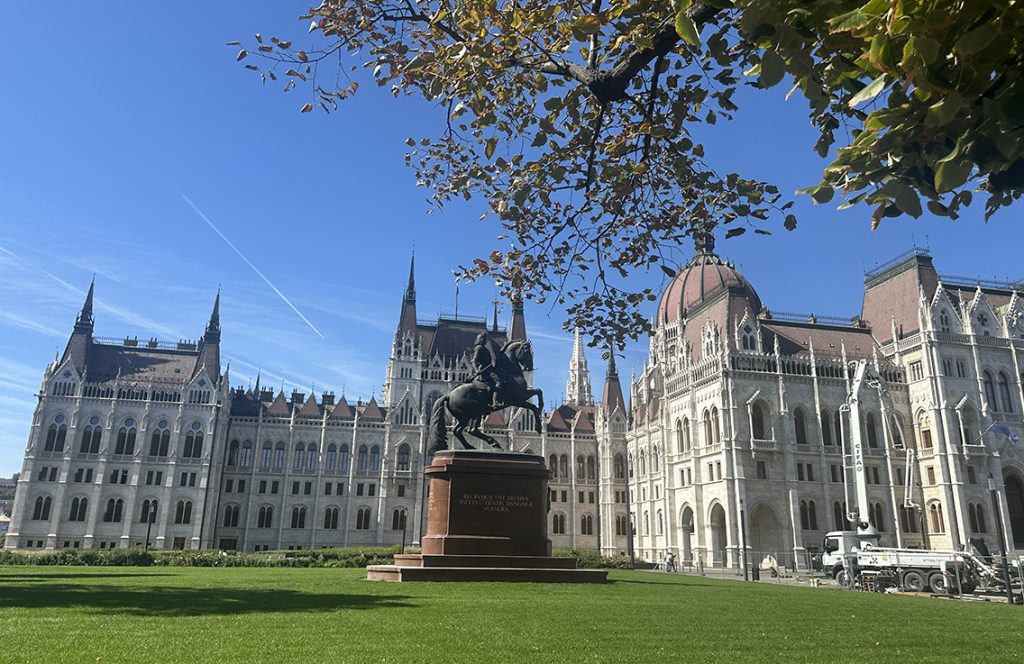
Its central dome is 96 meters high and symbolizes the nation’s founding in 896 AD.
Afternoon River Walk
Shoes on the Danube River Promenade
After my tour ended, I walked down to the Danube River to find the Shoes on the Danube River Promenade (which is just a 5-minute walk from the Parliament).

I saw women’s shoes, men’s shoes, and children’s shoes (the old-fashioned types worn in the 1940s).
“They sit at the edge of the water, scattered and abandoned, as though their owners had just stepped out of them and left them there.”—The World Holocaust Remembrance Center
The rusted shoes, made of iron, are set into the concrete of the embankment. The installation was created in 2005. (Click this YouTube link to see the Holocaust exhibit.)
Szechenyi Chain Bridge
I continued to walk down the riverbank toward the Szechenyi Chain Bridge. The majestic lions (symbol of Budapest) are guardians on the massive stone pillars. You must walk across this bridge to the Buda side. Stop halfway across to take in views of the Danube—boats below, Parliament on one side, Castle Hill on the other.

Completed in 1849, it was the first permanent bridge to connect Buda and Pest. Previously, the two sides of the city (Buda and Pest) were linked only by ferries or temporary pontoon bridges. English engineer William Tierney Clark designed it. Scottish engineer Adam Clark built it. It was the largest suspension bridge in the world at the time.
Afternoon: Bike Tour
Book a late-afternoon bike tour to see the Buda side of the city. Multiple tour companies offer 2.5-hour bike tours. You can choose between a traditional bike and an e-bike. It cost 35 euros.
However, I also recommend checking tour aggregators, such as Booking.com, Viator, and GetYourGuide, to explore all the bike tours available in Budapest. You might prefer a 10 a.m. tour (after the morning rush hour ends).

I was the only person on the 4:15 p.m. tour, so the company used a new guide. A senior tour guide “shadowed” him. Both young men were very friendly. But I found riding an eBike to be quite complicated during evening rush hour. Weaving my eBike through crowds of pedestrians when crossing the streets and riding along the bridge, I panicked when scooters came up behind me to pass.
I was afraid of crashing into a pedestrian. My guides sometimes rode on ahead of me, and I was caught behind. In retrospect, I wish I had taken a morning bike tour with four or five participants. We might have ridden our bikes at a slower pace.
Buda: Castles, Churches & Cobblestones
My eBike tour consisted of 15+ stops in the Buda and Pest neighborhoods. After picking up my ebike, we rode to Elisabeth Bridge. Then we visited the Buda neighborhood, including the statue of St. Gellart, the Budapest Funicular, the lower and inside Fisherman’s Bastion, Buda Castle, and Sándor Palace.
The most exciting part was putting my eBike into second gear and rapidly climbing the hilly streets to the Castle complex. Since I didn’t have to navigate past pedestrians and other bicyclists, I wasn’t scared.
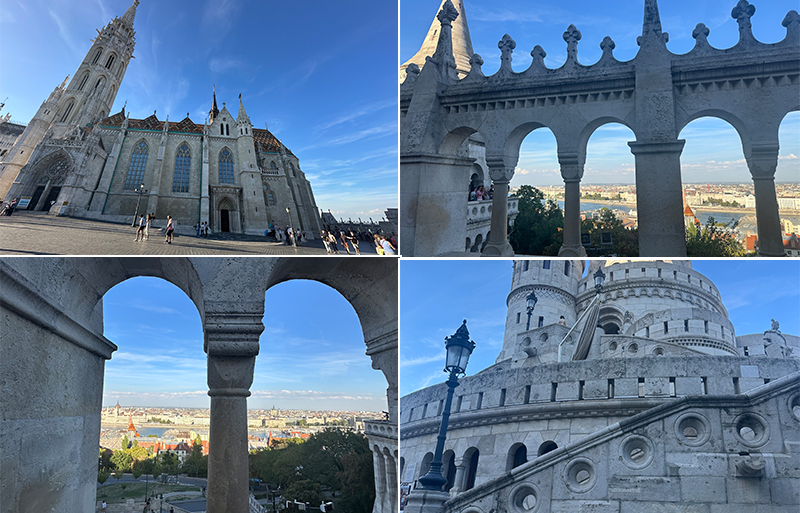
I will never forget the thrill of reaching Buda Castle, a UNESCO World Heritage Site. Gazing in wonder, I climbed off my eBike and stared at the map of the Buda Castle District, which reflects Hungary’s centuries of royal history. (Click this YouTube link to walk around Fisherman’s Bastion.)
- Matthias Church: Famous for its colorful tiled roof and Gothic spires, this church is a must-see.
- Fisherman’s Bastion: With its panoramic terraces, this neo-Romanesque lookout offers one of the best photo spots in Budapest. I had to wait several minutes before I could take a photograph of the Pest side of the city.
- Medieval Jewish Chapel: Used during the early Middle Ages and the Ottoman Turkish occupation, this Prayer House is a unique attraction that shares the history of the Jewish community from the 13th to the 17th century in the town of Buda.
My guides gave me 15 minutes to wander around, but I recommend spending half a day and booking a castle walking tour.
Margaret Island: Journey to Other Worlds
We bicycled back down Buda’s hilly streets to cross through the city and reach Margaret Island. The island is named after Saint Margaret of Hungary (1242–1270), who was the daughter of King Béla IV of Hungary.

Margaret Island is a public park located in the center of the Danube River in Budapest. I toured the ruins of the island’s 13th-century Dominican convent where she lived. (Margaret was offered to God by her parents, King Béla IV and Queen Maria Laskarina, following the Mongol invasion of Hungary in the early 1240s.)

I also walked through the nearby small Japanese gardens. Ducks quacked in the small pond in the center. A musician played his singing bowl. Pedestrians sat at every bench, staring at the tree branches dancing in the wind. (Click this YouTube link to take a stroll around the pond.)
I decided to end my eBike tour after I reached the Parliament, as I had already visited these tourist landmarks.
Sunset City Walk
As the sun set, Budapest glowed like a tapered candle. The city’s landmarks were illuminated, casting golden reflections on the Danube. A Budapest evening walk is one of the best ways to admire:
- Parliament
- The Chain Bridge
- Buda Castle and Matthias Church
For dinner, try a Hungarian restaurant. My hotel recommended the Ruben Restaurant, located in the heart of Budapest near the Karolyi Garden.

For my appetizer, I ordered the mushroom cream soup scented with truffle oil and served with vegetable shavings. I chose Wiener Schnitzel, fried in homemade breadcrumbs and served with parsley potatoes and cucumber salad with sour cream. There was no room for the traditional Hungarian walnut sponge cake for dessert. I was stuffed.
Early Morning Architecture Tour
If you can manage to set your alarm at 7 a.m., you can fit in an Art Nouveau architecture walking tour and see famous Hungarian Art Nouveau buildings before you call your Uber to go to the airport. Luckily, my hotel was located in Pest, which was home to multiple buildings.
Art Nouveau buildings feature floral motifs, curving organic lines, flowing asymmetry, and (sometimes) certain tilework. Some buildings use Hungarian folk-inspired ornament. Below are several Art Nouveau houses that I visited in Pest:
Thonet House
Ödön Lechner built the Thonet House, an Art Nouveau masterpiece in Pest, in 1890. The architect installed a majolica-tiled façade, which is a hallmark of his style. It is located at V Vaci utca 11/a.

There are decorative “T” motifs, which are a nod to the Thonet family, who commissioned the house.
Adria Palace
I visited the Adria Palace, which was built between 1900 and 1901. Look up to see the mosaic on the top façade, which depicts the Virgin Mary. Rays of light surround her.

Hungarian historical figures flank her. Miksa Roth designed the mural.
Parisi Udvar
Next, I visited the nearby Parisi Udvar. Architect Henrik Schmahl built it between 1909 and 1913. The Hungarian Art Nouveau building was originally a shopping arcade, inspired by the grand covered passages of Paris.

It is now a luxury hotel.
Budapest Postal Savings Bank
I decided to risk a brisk walk to Liberty Square to see three more famous Art Nouveau buildings. My favorite was the Budapest Postal Savings Bank (Magyar Postatakarékpénztár). Odon Lechner built it in 1901. It combines folk motifs and colorful tiles.

Postscript
I ended my whirlwind 24-hour tour of Budapest at the House of Strudel (Első Pesti Rétesház). It is located at Október 6. u. 22. The high-ceilinged café in an 1812 building serves the best fruit studel, as well as goulash and Hungarian fish soup.

I bought two slices of the sour cherry strudel and headed back to my hotel to call my Uber. (I should have bought three slices!)
Solo Travel Tips for Budapest
- Best photo spots: Fisherman’s Bastion, Chain Bridge, and Parliament at night.
- Getting around: Budapest is walkable, but trams and the metro are convenient for covering longer distances.
- Safety: The city feels very safe for female solo travelers, especially in the well-lit central districts.


22 Comments
Sonia
September 27, 2025 at 9:29 amWhat a packed 24 hours! I love that you were able to fit in the House of Strudel after seeing so many top sights.
Terri
September 28, 2025 at 7:34 pmThe House of Strudel was the best part about my visit to Budapest. Their sour cherry strudel was delicious!!!
Cosette
September 27, 2025 at 9:32 amBudapest sounds like a beautiful city to visit, lots of history to find. An e-bike tour sounds like a perfect way to explore. You get explanation and can cover some more ground then when you do a walking tour.
Terri
September 28, 2025 at 7:34 pmThe e-bike tour is a tremendous way to cover a lot of ground but also get a guide’s description of the history.
Amy H Tull
September 27, 2025 at 9:42 amWhat a timely post! We head to Budapest next week! I am definitely planning on cycling on Margaret Island.
Terri
September 28, 2025 at 7:33 pmLucky you! I hope you enjoy your stay in Budapest. I think you will love bicycling on Margaret Island. It is a paradise.
ANUKRATI DOSI
September 27, 2025 at 10:42 amThe 24-hour Budapest guide is amazing. The mix of walking and biking makes it easy to experience the city fully. The tip about evening bike traffic is very helpful and practical.
Terri
September 28, 2025 at 7:33 pmI did like the combo of a walking tour and a bike tour because it helped me see more of the city.
Kristen Thomas
September 27, 2025 at 11:02 amThis guy is a dream come through. Heading there in a week and definitely using this. Can’t wait for more.!
Terri
September 28, 2025 at 7:29 pmGreat!
Amy Poulton
September 27, 2025 at 1:10 pmBudapest has been on my bucket list for a long time – thanks for the great guide! Hope I can make it there soon.
Terri
September 28, 2025 at 7:28 pmBudapest was on “my list” for decades. It is never too late to visit – tremendous city!
Patricia (Tish) Mikan
September 27, 2025 at 2:47 pmWow Terri. This trip was amazing!!
I love the History as well as the great Architecture
Seems like Budapest has a lot of personality esp Uncle Karl. Sometime I will visit Thanks
Terri
September 28, 2025 at 7:32 pmBudapest was a delight. I love visiting these regal capitals in Europe. Uncle Karl was very friendly. Every tourist wanted to get a photo with him.
Irma R Franco
September 27, 2025 at 5:21 pmHi Terri, what an adventure!!!
Keep sharing these traveling treasure pearls with us! I love it!
Irma
Terri
September 28, 2025 at 7:31 pmThank you Irma!
Shweta
September 27, 2025 at 10:14 pmGreat use of 24 hours. Looks like a perfect day in Budapest. We also love to take walking tours of old towns, best way to see all the history and get some local flavour.
Terri
September 28, 2025 at 7:31 pmWalking tours are the BEST! I always tell my readers to do a walking tour on the first day that you arrive in a city. It is the best to learn from a local about what to see and do … as well as the best restaurants to book (where the locals eat).
Catherine = Savvy Family Travel
September 27, 2025 at 11:04 pmI had to lookup the story behind King Stephen I’s mummified right hand!
Terri
September 28, 2025 at 7:28 pmHaha – good student of history!
Anja
September 28, 2025 at 5:30 amI love Budapest! The architecture and the cafes are so stunning. Unfortunately, when I last visited, it was December, it was dark by 16.00 and sooo cold I spent half the day in the thermal baths… I know there might be better places to go to relax, but for a city, Budapest has some stunningly beautiful thermal baths, too
Terri
September 28, 2025 at 7:30 pmI think choosing the thermal baths over a walking tour in the cold was the wise choice! I was disappointed that I didn’t get to try the city’s famous thermal baths. Oh well, I guess I need to visit again.