

This article is also featured on GPSmyCity. To download this article for offline reading or create a self-guided walking tour to visit the attractions highlighted in this article, go to Walking Tours and Articles in Atlanta.
Atlanta’s Cabbagetown feels like a neighborhood caught between two worlds. Historic mill cottages line narrow streets while giant murals stretch for blocks across warehouse walls. One moment, you are admiring wildflower gardens beside porches. Next, you are walking through a railroad tunnel covered in layers of graffiti and street art.

What makes Cabbagetown special is that it still feels authentic. Artists, longtime residents, coffee drinkers, muralists, dog walkers, and photographers all seem to share the same sidewalks. The neighborhood grew around the massive Fulton Bag and Cotton Mill in the late 1800s and has transformed into one of Atlanta’s most creative urban districts.
I decided to visit Cabbagetown on a recent business trip to Atlanta. After walking the city’s famous BeltLine Eastside Trail, I detoured to see Cabbagetown’s famous street art. This self-guided walking tour takes 60 minutes. But I suggest that you linger at a neighborhood cafe at the end.
Table of Contents
Start at the Krog Street Tunnel
Begin your walk at Krog Street Tunnel, Atlanta’s most famous graffiti tunnel. The tunnel connects Cabbagetown and Inman Park.

It serves as an outdoor art gallery, with its walls constantly changing. Layers of tags, political messages, portraits, and colorful spray-painted murals cover nearly every inch of concrete.

The tunnel is loud (from traffic), chaotic, and unforgettable. It feels like Atlanta proclaiming its creative spirit in giant letters.
Walk the Forward Warrior Murals Along Tennelle Street
After exiting the tunnel, continue right toward Wylie Street and Tennelle Street, where the annual Forward Warrior mural project transformed train walls into one of Atlanta’s largest outdoor street art collections. There are benches at the end of the tunnel, so you can stop to look at your Google Map app.
The murals stretch beside rail lines and walls. I think there are more than 50+ murals. I lost track. It took me over an hour to walk from the tunnel (starting point) to the end of the wall at the old mill.
Each year, older artists return, and new artists create new murals. In some cases, artists simply add to their old street art.
Forward Warrior is an annual arts event in Atlanta, made possible by the courageous support of the Cabbagetown Initiative 501c3 and generous contributions from people like you!”
The “Save the Date” is Saturday, September 18, 2026, for the next paint-a-thon.
Feline Street Art

During my walk, I discovered two memorable cat murals: the famous electrocuted cat mural and a striking red bandana calico cat painted beside the tracks. These quirky images perfectly captured Cabbagetown’s playful personality.
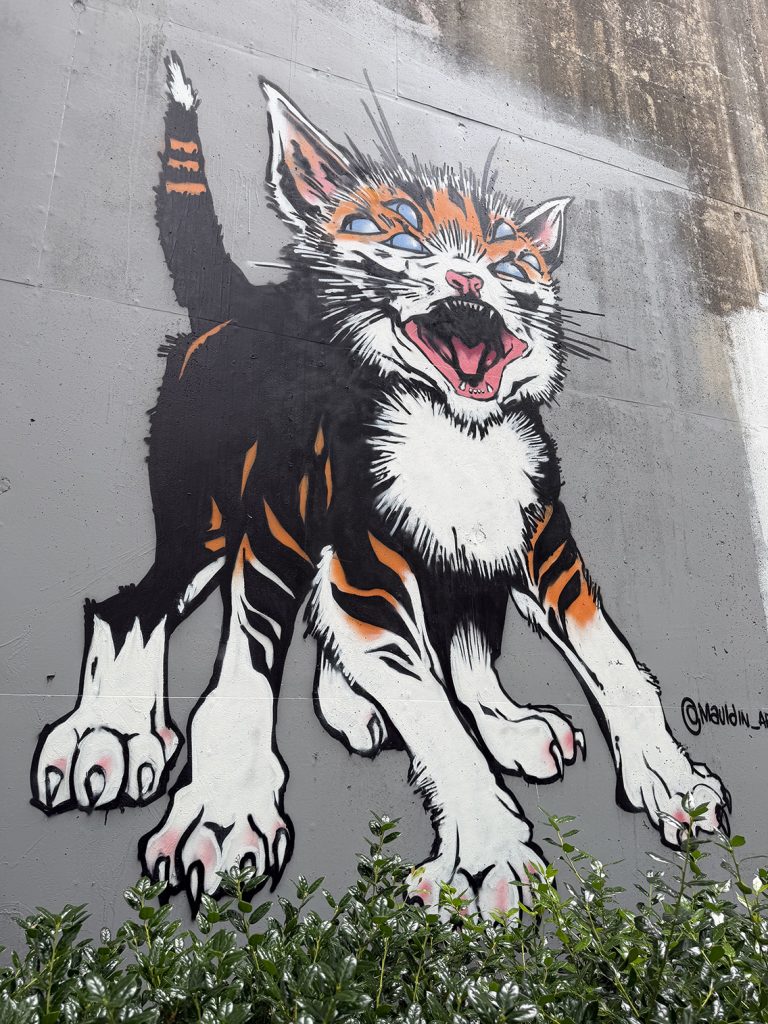
The neighborhood’s love of felines would become clear later in my self-guided walking tour.
The Fulton Cotton Mill Lofts
Soon, the massive brick buildings of the Fulton Cotton Mill Lofts rise above the cottages. The former Fulton Bag & Cotton Mill began operations in 1881 and once employed thousands of workers.

The scale is dramatic. Giant industrial brick buildings tower above tiny mill-worker homes. Today, the mill operates as residential lofts, but the smokestack and industrial architecture still tell the story of Atlanta’s manufacturing past.
Standing beside the old mill, it is easy to imagine generations of workers walking these same narrow streets over a century ago.
Wander the Residential Streets
The true charm of Cabbagetown appears when you wander side streets like Tye Street, Powell Street, and Berean Avenue.

Small bungalow cottages sit close to the sidewalks with wide porches, bicycles, and folk art. The gardens are unruly. Many residents plant wildflowers that spill across fences and sidewalks, softening the neighborhood’s industrial edges.
The homes were originally built for mill workers and remain surprisingly modest in size. Their narrow lots and front porches create an intimate streetscape that encourages walking and conversation.

For photographers, this is one of Atlanta’s most atmospheric neighborhoods. Murals appear beside century-old cottages while vines and flowers soften old fences and brick walls.
I frequently stopped to key in an address when I saw a For Sale sign. These cottages are premium real estate today. The cost for a 1,100-square-foot house was $700,000+.
Carroll Street: The Heart of Cabbagetown
Eventually, the walk leads to Carroll Street. The road is so narrow that cars slowly negotiate passage while pedestrians wander between cafés, cottages, and patios.
There are several restaurants, shops, and apartments. I think the Cabbagetown Cafe is the neighborhood’s social center. The café describes itself as a “Bohemian bistro” with a relaxed European pace. Sidewalk tables spill onto the narrow street while locals linger over coffee, brunch, or wine. A puppy sat close to its owner’s chair, as no dogs are allowed inside.

I particularly enjoyed the “green area” on Carroll Street between the neighborhood grocery store and the tattoo parlor. There are picnic benches for eating takeout. You will also find several murals.
Little’s Food Store: Bodega Cat
Nearby, Little’s Food Store feels like an old-fashioned neighborhood grocery store preserved from another era. It is nearly a century old. Its retro sign and casual atmosphere fit perfectly into Cabbagetown’s quirky personality.

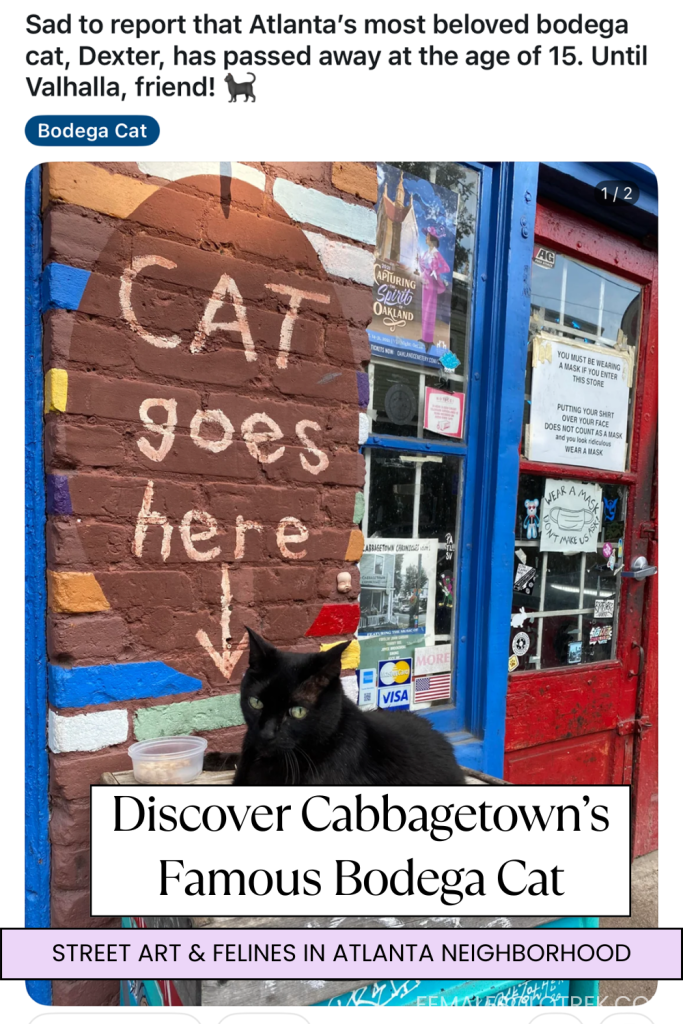
But what I loved most is that Little’s Food Store was the home of “Dexter,” the Cabbagetown bodega cat. Sadly, Dexter died two years ago.
Sad to report that Atlanta’s most beloved bodega cat, Dexter, has passed away at the age of 15. Until Valhall, friend.” (r/bodegacats)
But he is remembered by the sign outside the grocery store that reads “Cat goes here!”

In addition, the neighborhood installed a Cat Crossing sign.

I also saw cat paw prints painted on Carroll Street to warn motorists to slow down for this famous black cat.
Esther Peachy Lefevre Park and Local Landmarks
A quieter stop on the walk is Esther Peachy Lefevre Park, a small neighborhood green space tucked into the residential streets. The park offers a peaceful contrast to the bold mural walls nearby.

A nanny watched two children running around the swing sets and chasing each other.
Another memorable landmark is Emmanuel Spiritual Holy Temple Church, whose simple structure reflects the neighborhood’s deep roots and longstanding community identity.

These smaller landmarks remind visitors that Cabbagetown is not simply an arts district. It remains a living residential neighborhood with strong local traditions and history.
End Your Walk at Estoria Cafe
Finish the tour at Estoria Cafe, a colorful neighborhood café known for its relaxed patio and artistic atmosphere.

After several hours of walking through murals, cottages, gardens, and industrial history, Estoria feels like the perfect ending point for a creative Atlanta adventure.
Cabbagetown’s Name
Cabbagetown got its unusual name from the workers who lived there in the late 1800s and early 1900s while employed at the nearby Fulton Bag and Cotton Mill.
These poor mill workers were of Appalachian descent. According to local legend, they grew cabbage in their tiny gardens to help feed their families. Residents from wealthy areas of Atlanta christened this neighborhood “Cabbagetown” because it reeked of boiling cabbage.
While the name originally carried a class stereotype, over time, residents embraced it as part of the neighborhood’s identity.

Street Art Tour
If you’d like to learn more about special Forward Warrior street art, I suggest you book the “Atlanta Art and Mural Tour.” Unexpected Atlanta Tours currently offers this tour on Saturday afternoons. It costs $45. I decided to take the guided tour because I had so many questions about the Forward Warrior street art wall.

I discovered how street art is both a response to current events and often encourages response. There is a particularly moving section at the end of the wall (near the tunnel) dedicated to people who died, such as the bartender “Mariam” who was murdered. Her friends wrote messages on her mural, such as “a bright light extinguished too soon.”
Final Thoughts
Today, the name fits the neighborhood’s independent personality. Cabbagetown is proud of its historic working-class roots. Its tiny cottages are living history.
Ironically, what was once considered a poor mill village is now one of Atlanta’s most desirable intown neighborhoods
Cabbagetown may have started as a mill village, but today it thrives as one of Atlanta’s most walkable and visually fascinating neighborhoods. The mix of street art, architecture, gardens, and local businesses creates a neighborhood that rewards slow exploration and curiosity.


14 Comments
Laureen Lund
May 23, 2026 at 10:00 amFascinating. I am so sorry we did not know about this neighborhood when we visited. I would have loved this colorful and historic place. Thanks for opening my eyes for next time.
Terri
May 23, 2026 at 11:48 amCabbagetown is incredible. I loved it so much that I am booking an official Atlanta Street Art tour today. I can’t wait to learn more about the artists who paint the street art wall in the neighborhood.
Sonia
May 23, 2026 at 11:55 amCabbagetown’s history and street art would be fun to explore. I missed this during previous Atlanta trips, but it sounds like a great addition to future ones.
Terri
May 23, 2026 at 8:19 pmI think a lot of people miss Cabbagetown unless they walk the BeltLine. If you get down to the tunnel, you discover it.
Sara Essop
May 23, 2026 at 2:04 pmWalking tours reveal so much more than vehicle tours. Cabbagetown has a fascinating history and I’d love to explore it on foot and see the street art.
Terri
May 23, 2026 at 8:18 pmI am not a fan of bus tours either. I always believe that you can learn more on a walking tour. It took me almost 2 hours to examine the 80 different murals on the train wall in Cabbagetown.
Anita
May 23, 2026 at 2:28 pmCabbagetown seems like an intriguing place I had not heard of before. As a fan of street art, I would be interested in visiting if given the opportunity. Thank you for bringing it to my attention.
Terri
May 23, 2026 at 8:17 pmIt is an intriguing place. I know two residents of Atlanta that never heard of this neighborhood. This is the type of place that I love to discover when I travel. The street art is sublime.
Annie
May 23, 2026 at 4:05 pmSounds like a fascinating place, though as I avoid towns where possible, I’d be heading straight for the park! I’m glad you explained the origin of the name. We had a neighbour whose name I could not remember after I left home. But I felt it had something to do with cabbage. Many years later, I realised the name was Mrs Cole – as in cole-slaw – from the German word Kohl for cabbage. I hadn’t heard of cole-slaw back then, otherwise the connection may have been more obvious.
Terri
May 23, 2026 at 8:16 pmOk that is really cool how Mrs. Cole reminded you of coleslaw. I also make associations to remember the connection between people and words. I do think that naming this neighborhood “Cabbagetown” is fantastic marketing. Do you remember Cabbage Dolls? They were all the rage in the 1970s.
Mary Ann Kelly
May 23, 2026 at 7:09 pmTerri, felt like I was there. Wouldn’t it be cool to see the Fulton Cotton Mill Lofts? I think we’re a couple of inveterate walkers.
Terri
May 23, 2026 at 8:15 pmI would love to see the Fulton Cotton Mill Lofts. I notice that they have a fence to prevent the curious from sneaking into the lobby. I am an inveterate walker!
Teja
May 24, 2026 at 7:29 amI think guided tours are usually worth it for street art. There’s so much to know – who were the artists, what were they responding to – to appreciate them properly.
Patricia (Tish) Mikan
May 28, 2026 at 10:12 pmWow! I love Cabbagetown! So unique with all of its artwork, tunnel and Bodega cat
I would like to go there soon